
We are back with an update on the uranium sector, where we’ll briefly review more fundamental macro factors stacking up for this sector as further wind in the sails of the nuclear renaissance. Of course, we’ll also review some technical takeaways from a number of sector ETFs and individual company charts in the portfolio.
Some readers may have been expecting the next article to be the update from the PM Summit in Beaver Creek, and that is coming soon, but it is expanding into a multi-part series. Since it will be so focused on the precious metals and copper, and because the last few articles were on the precious metals, it seemed best to get this uranium update out to readers here in the interim.
All the positive endorsements of nuclear energy from sovereign nations to mega-cap tech companies, all the new reactor builds and reactor life extensions to feed growing global electricity demands, and the skewed supply/demand realities in the nuclear fuel cycle, are value drivers that are filtering their way down to increased U308 demand.
Even more investors are waking up to this burgeoning sector, and that is what we’ve seen playing out across the nuclear stocks, select utilities with heavy exposure to nuclear power, and the top-end of the uranium mining stocks. It still hasn’t really filtered down to the uranium explorers yet, but all in due time…
The uranium ETFs, producers, and developers have actually been in a recent stealth rally, since the April lows post Liberation Day. With so much resource investor interest lately focused on gold, silver, copper, and some of the niche critical minerals like antimony, tungsten, germanium, and rare earths; it equates to much of the traction that uranium stocks have been garnering being largely buried under all the other sector newsflow.
There are so many right-tail risks and positive surprises to the upside, that this sector still has very bullish fundamentals for the foreseeable future in the medium to longer-term.
So, let’s get into it…
As we have discussed in the past, there truly are a bevy of positive catalysts stacking up for nuclear power and thus increasing uranium demand. There is a global resurgence in interest for more nuclear power by so many nations to meet their carbon-free energy expansion guidelines, along with interest from large tech companies for powering their AI datacenter buildouts. There has also been a steady stream of announcements of new construction or plans for additional reactor builds all over the planet, in addition to reactor restarts and reactor life extensions.
However, what everyone seems to have forgotten in the flurry of the last year’s news cycle and all the constructive headline drops clamoring for future small modular reactor builds and further adoption of larger reactors being built globally, is that uranium was already in a structural supply deficit. Even if we just kept the nuclear fleet exactly the same size it is and if there was no projected growth, then there still aren’t enough pounds of uranium coming onto the market in the next 3-5 years from mine supply to keep up with the current demand; much less meet growing demand.
This US administration has been particularly active this year issuing 4 executive orders to stimulate the nuclear power industry, increase more processing and enrichment domestically and from friendly nations, and more investment into the whole supply chain of the nuclear fuel cycle. Additionally there were parts of the prior administrations ‘Inflation Reduction Act,’ and this administration’s ‘Big Beautiful Bill’ focused on development of strategic minerals infrastructure and expediting permitting, including that for nuclear power and uranium mining.
The good news keeps rolling in for the sector: This week the topic of building a US strategic uranium reserve resurfaced as a policy initiative.
Uranium stocks soar as US plans to boost strategic stockpile
Investing.com - 09-15-2025
“Uranium stocks surged on Monday after U.S. Energy Secretary Chris Wright signaled plans to increase the national strategic uranium stockpile.”
“Energy Fuels Inc. (NYSE:UUUU) extended gains to rise 9%, while Uranium Energy Corp. (NYSE:UEC) climbed 6% and Cameco Corporation (NYSE:CCJ) advanced 7% following Wright’s comments in an interview in Vienna, as reported by Bloomberg.”
US Looks to Boost Uranium Reserves for Nuclear Power
Jonathan Tirone – Bloomberg - September 15, 2025
“The Trump administration’s top energy official said the US should look to boost its strategic uranium reserve to buffer against Russian supplies and increase confidence in the long-term prospects of nuclear power generation.”
“US Energy Secretary Chris Wright’s comments underscore the Trump administration’s plans to promote nuclear energy as the demand for power soars with the electrification of the economy. Russia supplies about a quarter of the enriched uranium needed by America’s fleet of 94 nuclear reactors, which generate about a fifth of US electricity. Turning the tap off too quickly from that source could endanger about 5% of electricity in the absence of alternative suppliers or additional stockpiles.”
Again, this is just one of dozens of positive news developments in the nuclear power sector that we’ve seen over the last year or so, and you can bet that more catalysts will keep coming in. Nuclear power continues to be embraced and the new light being shed on this sector clears away the cobwebs of disinformation about this critical power input. More and more analysts are working their way down the nuclear fuel cycle and waking up to supply/demand mismatch that has been developing for some time with regards to uranium.
There is a supply pinch-point that everyone knows is coming for various utilities in 2026, 2027, 2028, and 2029, whether they are ready to face that reality yet or not… and that was bound to happen even if there were no new reactors being built, no strategic reserves proposed, and before AI data centers were the topic du jour.
And sorry, but NO… NexGen’s Arrow is not going to save the day anytime soon. All those high-grade pounds are not coming to the market anywhere before 2030 at the earliest, but more likely in 2031 or 2032; despite all the rosy pundit projections and utilities’ fever dreams for the last handful of years.
Arrow is undeniably an amazing high-grade deposit, and sure… lots of future supply will come from their deposit, but that’s all at least 5 years off, and that doesn’t help utilities in the slightest that need new pounds of uranium in the next few years of this current cycle.
There has been so much disinformation for years now about when this project was going to be acquired by a Major, or built internally, and actually see production come online, to magically fill the supply gap. Unfortunately for utilities and uranium investors, a lot of folks ate up those extreme overly optimistic projections that Arrow is “the only project the world needs,” and shrugged off the harsh realities of just how long it will take to bring a project of this scale into commercial production.
In full disclosure, I’m a big fan of NexGen (NXE), and have been a shareholder since back in 2016, (long before most current bulls were pounding the table on the importance of this asset). I absolutely have celebrated their success in defining a world-class tier one asset.
However, it’s been quite frustrating to witness the decade-long herd-think and incessant brow-beating about how this one project “will balance the sector” and that “no other projects are even needed” from very biased pundits and overly exposed investors with an extreme axe to grind. Again, yes - it’s a monster project, but the world needs a lot more than just one project or one company, and they need it long before the next 5 years.
As is often the case in resource investing, many “experts” advice needs to be swallowed with more than few grains of salt. Those that have espoused Arrow as the sole solution, to the exclusion of everything else, have done so at the detriment to the rest of the sector, and missed plenty of other compelling development and production opportunities over the last 5 years. Arrow is a great deposit… but this global sector starved for pounds of uranium needs more than just the potential of Nexgen.
Denison’s Phoenix deposit is slated be producing new uranium supply by late 2028 / early 2029, ahead of NexGen’s Arrow. That is… if all goes perfectly with their ISR mining strategy, but that extraction approach has never been tested at commercial scale yet in in the Athabasca Basin. Besides… we are still in 2025, so that’s still 3-4 years out before any new production comes to market.
As a result, the jury is still out until we can all see if they can deliver on their stated future production guidance and we still won’t know for several years. Even IF it works commercially, there will not be enough new supply from Denison to fill the growing demand gap for new pounds of U308.
Denison does have some uranium stockpiled that it purchased in the spot markets, that it can deliver into contracts; if there are any challenges in ramping up into production.
In full disclosure, I’ve also been a shareholder of Denison since late 2016, and have traded around a core position, buying some on dips and selling some on rips, for about a decade now… so, I’m rooting for the company’s success. My sincere hope is that we do see this project start up on time and on budget, because the world really needs their uranium.
Paladin’s Triple R / Patterson Lake project, that they acquired from Fission last year, is even further back in the development cue, and won’t be saving the utilities demand for new pounds anytime soon.
Some analysts have advocated for NexGen’s Arrow Project and Paladin’s Triple R/ Patterson Lake Project to be developed jointly, for synergies in infrastructure, resources, and labor; but it doesn’t appear either company is working on a joint development plan.
Additionally, Paladin’s restart of Langer Heinrich Mine operated in Namibia has taken longer than expected to ramp up and has underperformed guidance, so even those pounds have taken longer than expected to get out to market and in smaller amounts.
Niger nationalized the French nuclear company Orano’s old mines, and simultaneously stalled the advancement of other development projects in country, so don’t look there for an influx of new pounds of fuel anytime soon.
Turning to the big boy uranium producers, Cameco has not been flexing up production like so many analysts predicted they would, because they are having challenges finding specialized and skilled labor; not to mention they are receiving less pounds from their JV with Kazatomprom than forecasted.
Cameco does have the ability to increase their production output eventually; and will likely do so when they have sufficient staff and enough longer-term off-take contracts in place, at pricing terms that they find constructive for longer-term business growth and development.
They have 2 huge mines, that are depleting assets, but they also have large exploration potential in the Athabasca Basin. Additionally, they have US assets in their portfolio, where they could turn on more production as this cycle unfolds.
Cameco also has a 49% stake in Westinghouse, and so they are a play on nuclear reactor builds and nuclear infrastructure, as well as uranium mining and fuel sales.
Kazatomprom, the largest swing producer in the sector, has not been able to ramp up their ISR production nearly as much as some pundits were so sure they would be doing over the last few years.
At their operations in Kazakhstan, there have been a few different reasons for these setbacks from challenges acquiring sulfuric acid and timeline extensions in building their own plant, to new tax laws in country that stifle growing output too quickly; not to mention a general lack of investment in development of their assets.
Some pundits close to the company have also noted a large amount of internal management turnover, which typically does set most organizations back until they find their footing and grow a sustainable culture and work strategy.
Combine that with the reality that everything takes longer and is more complicated in mining and extractive industries than politicians, policy makers, and pundits anticipate and the truth is that we’ve not seen them “flood the market” with all these new supposed pounds of uranium the last few years. (Yeah… there were “experts” out the last 5 years suggesting that uranium prices would never make it over $40 because the Kazakh’s were going to flood the market with new supply to elbow out all other producers and maintain their market share… Um… Nope.)
Turning to the smaller US producers, (you know the group that many investors strictly infatuated with the Athabasca Basin loved to diss and rip on as garbage and meaningless), they’ve also had their share of setbacks, but at least they’ve actually brought on some of the ONLY NEW PRODUCTION OF U308 IN YEARS, with exception of a little bit out of Australia from Boss Energy.
Granted, the production amounts from the handful of US operators (Energy Fuels, UEC, enCore Energy, Ur-Energy, and just this month Peninsula) are much smaller in comparison to the juggernauts of Cameco and Kazatomprom; but they’ve at least gotten into production IN THIS CYCLE. These US producers are taking advantage of the rising underlying uranium pricing, which is a boon for investors that would like to see companies generating revenues today.
Additionally, all of the US Executive Orders and fiscal bills passed in the last 2 administrations, with funds to expedite domestic supplies and processing of nuclear fuels, gives these US uranium companies a distinctive edge on the global scene. Many stocks have received a premium valuation for just these reasons and we’ll get into that later when we look at their pricing chart data.
Bottom line: ALL of the models for new uranium supply that would come online to “balance the markets” have been wrong for many years now, and were far too optimistic.
We’ll continue to see these same kinds of overdone projections for supply paired with the typical delays and setbacks in the mining sector, as new supply tries to eventually ramp up. So, the picture coming into focus begs these questions:
Where will the new pounds of uranium come from in the interim, over the next 3-5 years?
If there aren’t enough pounds of U308 to provide to utility companies, then what will the price response need to be in both the spot market, and more importantly, in the term markets to increase expedited production?
Even if the spot and term price of uranium was $100, $120, or $140 could we really see that much more production come online in 2, 3, or 4 years?
Over at the KE Report on Monday September 15th, Justin Huhn, Founder and Publisher of the Uranium Insider, joined me for yet another very comprehensive macro update on the supply and demand fundamentals for uranium and the nuclear fuel sector.
After just getting back from the World Nuclear Symposium in London, Justin provided some boots-on-the-ground feedback as to the longer-term contracting cycle is setting up with utility companies, different bottlenecks in the conversion and enrichment portions of nuclear fuel cycle that he is watching, and how he is positioning in the uranium equities to feed the front end of that supply chain.
Now let’s review a number of technical setups on the charts of uranium stocks and ETFs:
First off, let’s review that this bull market in nuclear stocks and uranium stocks is not “just getting started,” and in reality this bull run is about 5 years long at this point.
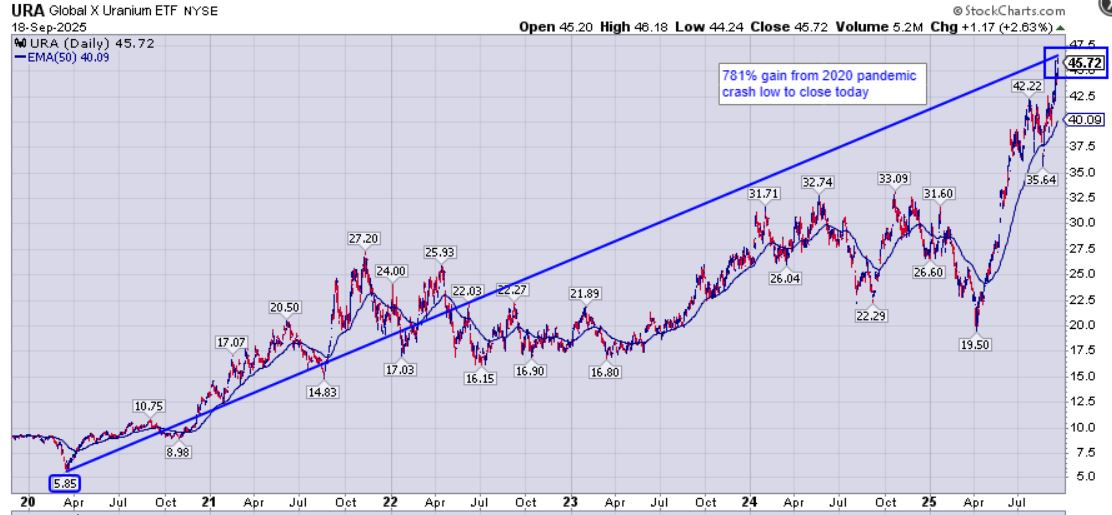
The Global X Uranium ETF (NYSE: URA) is up 781% (almost 8X) off the 2020 pandemic crash Major Low at $5.85 through today’s close at $45.72.
Despite uranium in its name, the allocation inside of URA has had positions in technology companies that are building reactors as well as enrichment and utility companies over the years; so it’s not a pure reflection of the uranium stocks in isolation.
We’ve seen 3 good bullish impulse waves higher: (1) from March of 2020 through November of 2021, then (2) March of 2023 through January (with another snapback rally into May) of 2024, and then (3) a big surge from the April tariff tantrum low through present in 2025.
While this move seems quite advanced at this point, keep in mind that the price of (URA) got up $134.52 in 2011 at the peak of the last cycle. So, this ETF would need to essentially triple in price to get back to that prior level.
The Sprott Funds Uranium Mining ETF (NYSE American: URNM) is a better visual representation and is in more alignment with whipsaw nature of the bull market in uranium equities over the last 5+ years.
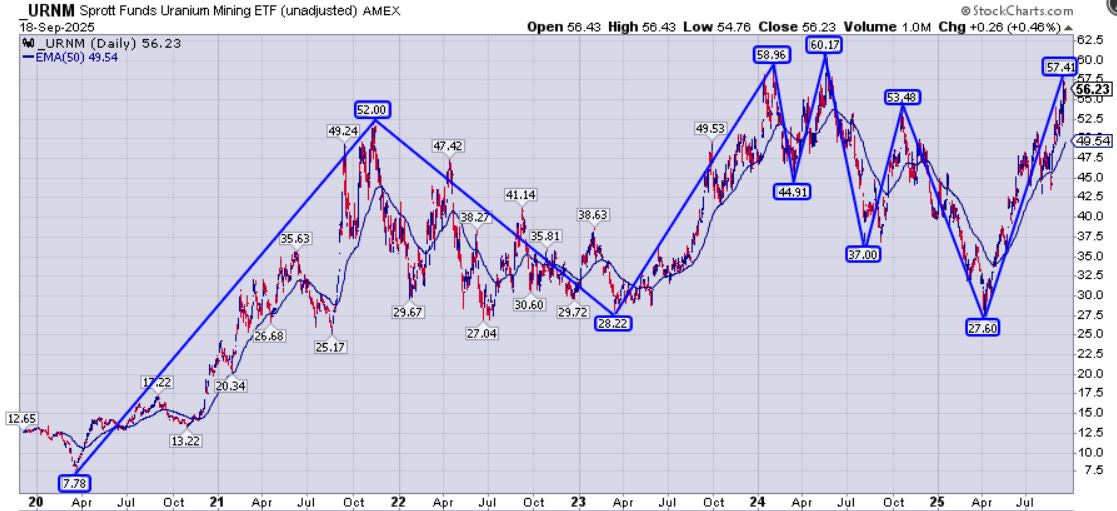
(URNM) has had several multi-fold runs over this period of time (also with 2 significant cyclical bear periods), and it is up 738% from the March 2020 pandemic crash Major Low at $7.78 through Thursday’s close on September 18th at $57.41, for the duration of this secular bull cycle thus far.
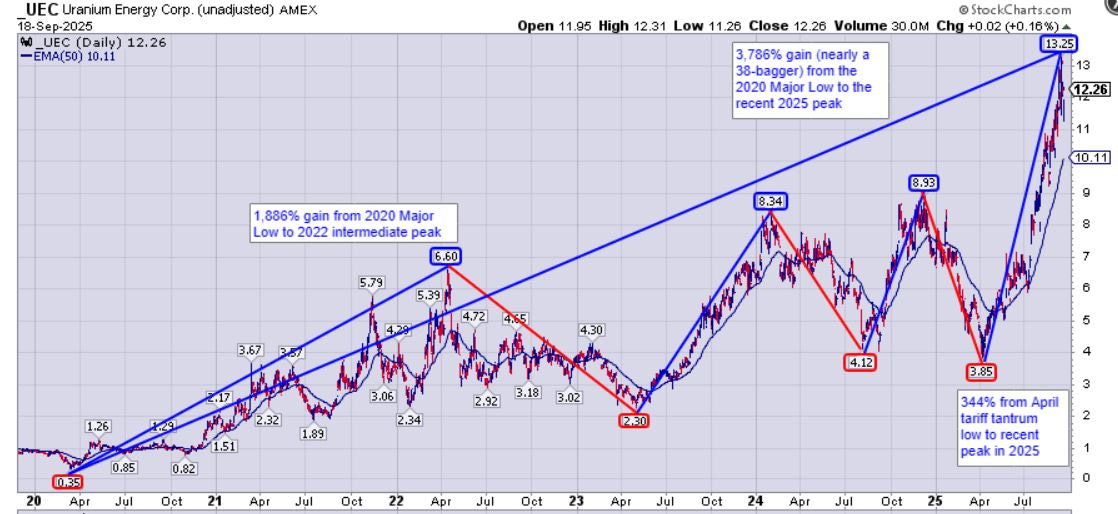
(UEC) has blown away the uranium ETFs, and outperformed most other stocks in the sector for that matter. It has definitely been the top performing U-stock in my portfolio over the years. It is also a great highly-liquid stock for trading and I’ve literally traded around the core position dozens of times over the last decade, cycling through it over and over again.
(UEC) went up 1,886% from the 2020 Major Low during the pandemic crash at $0.35 to the 2022 intermediate peak at $6.60.
(UEC) went up 3,786% (yes almost a 38-bagger) from the Major Low at $0.35 to the recent peak at $13.25. That doesn’t mean any investors caught all of that move, but highlights how much potential there was in this trade over the last 5+ years for investors to accumulate at many spots and to capture massive gains in this cycle.
I’ve been hearing since 2016 that Uranium Energy Corp was a sham, run by serial promoters, that it would never get into production, and that its assets are not worth much. Meanwhile, UEC has amassed the largest domestic resources held by any US operator, and they’ve acquired a number of world-class Canadian assets to balance out their pipeline of projects. Oh, and by the way… they did make it into production, despite all the naysayers prognostications.
This is likely a bitter pill to swallow for all those uranium bugs that love to hate on this company, and a key reason that we as savvy investors need to tune out the sector narratives and noise and focus on the technical charts and upside potential when investing in any resource stock. The herd is usually wrong, and repeatedly misses the biggest gainers… whether it is gold, silver, copper, oil, or uranium.
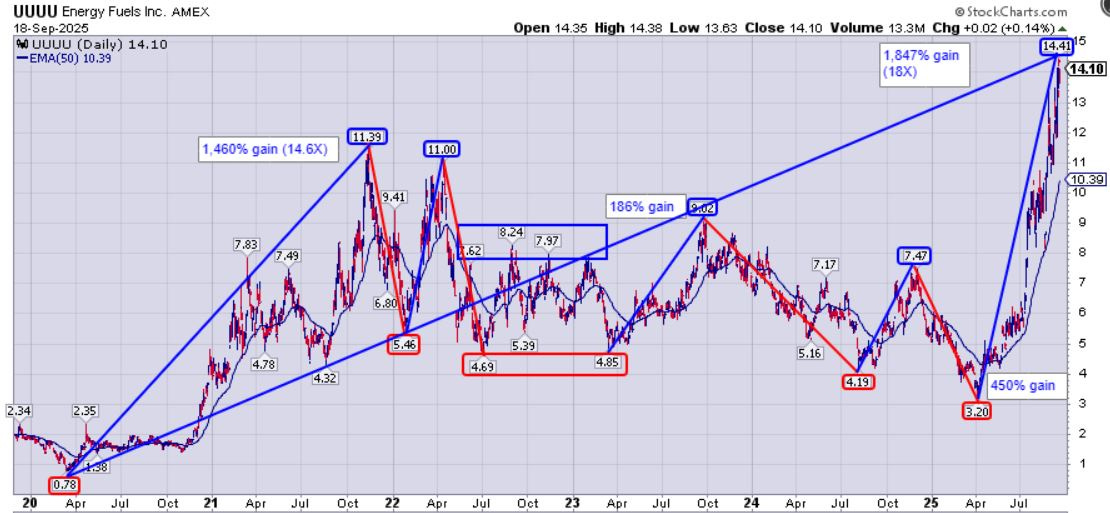
Energy Fuels (NYSE American: UUUU) is a complex company that has compelling mix of uranium, rare earth, and even vanadium deposits in multiple jurisdictions. They are currently producing uranium and rare earths out of Utah in the US, and have had a very messy whipsaw chart for many years now.
From the pandemic crash 2020 Major Low of $0.78 to the 2021 peak of $11.39, the stock had a 1,460% gain.
From the pandemic crash 2020 Major Low of $0.78 to the recent peak of $14.41, the stock has had a 1,847% gain (an 18-bagger!).
In fairness, this stock peaked harder and earlier than many other uranium stocks earlier in this cycle, but then mostly corrected sideways to lower over the last few years. As a result, most investors have not held their position from the lows to the recent highs. I’ve been invested in this company for over a decade, and did actually add aggressively to it in March of 2020, but have traded around the core position dozens of times, and lighted up for periods of time in the 2022-2023 zone.
The big run in (UUUU) up 450% higher since the April tariff tantrum low of $3.20 to the peak at $14.41 recently, was aided by the tailwinds in the nuclear sector and uranium stocks; but I would submit even more so by the surge in rare earth stocks over the last few months (due to Chinese export bans spiking many of these related REE stocks).
Energy Fuels is a great way to get dual-pronged exposure to both uranium and rare earths production, out of the USA.
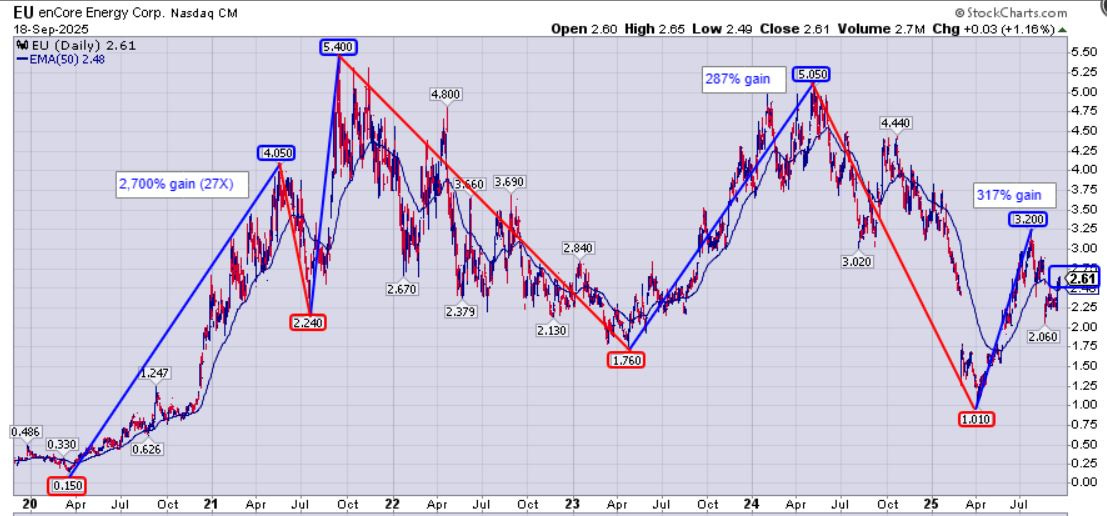
enCore Energy has been on a wild rollercoaster ride over the last handful of years. It is in production now in the US, but had a few challenges and setbacks over the last year, and is just now starting to dig out and get escape velocity.
(EU) had a stunning initial 2,700% (27X) bullish impulse leg higher off the March 2020 Major Low at $0.15 up to the 2021 peak at $4.05.
After a swift correction down, it actually ran up even higher to $5.40 by later 2021 for a cumulative 3,600% gain (a 36-bagger!) from Major low to that peak.
Personally, I acquired 7 more tranches of (EU) from December of 2024 through April of 2025, averaging down in my most recent cumulative position. As a result, I’ve seen the benefit of “buying low” when so many were throwing out the domestic uranium production baby, with the temporary negative operational news bathwater. I still see multi-fold rerating potential as the company proves to the market that they’ve got their ship turned around operationally over the next few quarters.
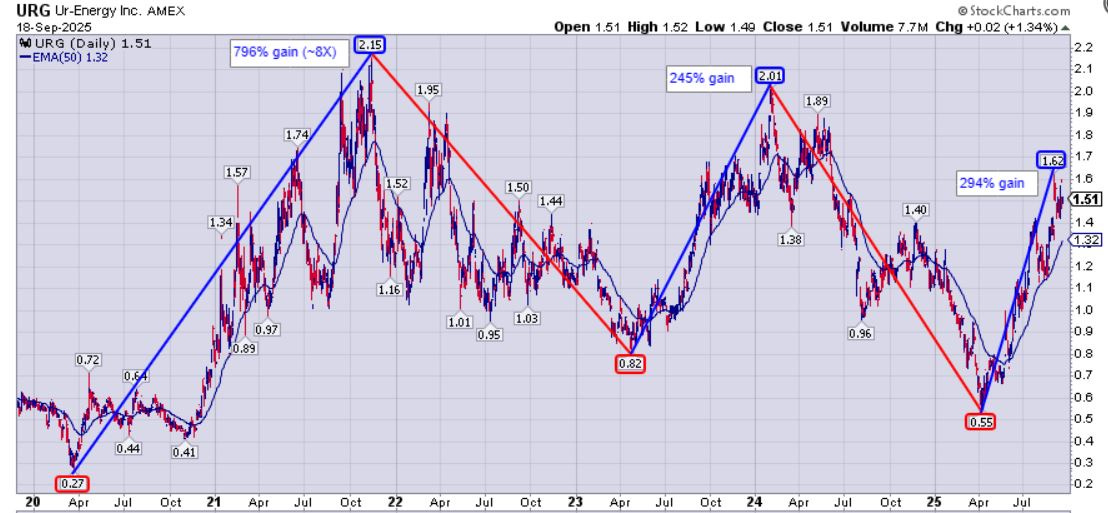
Ur-Energy (NYSE American: URG) is a smaller ISR uranium producer operating in the US. It has not had as epic of moves as some of the other US producers, but still it’s had a number of good blasts higher over the last 5+ years.
From the March 2020 low of $0.27 to the $2.15 peak in late 2021 (URG) surged 796% for a near 8X move, to kick off the first leg of this cycle.
This stock has since seen 2 different 2.5X moves higher off intermediate lows.
I see (URG) as an acquisition target for the inevitable consolidation of some of these smaller US uranium producers. Same thing with Peninsula Energy.
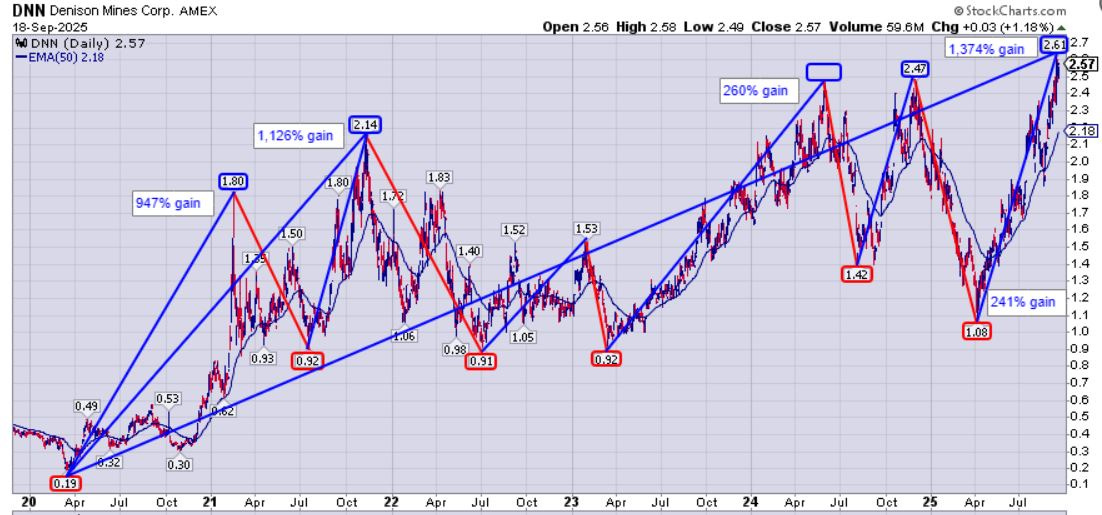
Denison Mines (NYSE American: DNN) is a popular uranium developer, that has been a producer in past cycles with different assets. The company is working towards the development of its Phoenix Project in the Athabasca Basin, with the goal to go into ISR production in late 2028. We discussed this project earlier in this article, and Justin Huhn expanded on this in our podcast linked above.
(DNN) can really move on sector rallies, going up 947% from the March 2020 Major Low of $0.19 to the March 2021 peak of $1.80.
(DNN) had a swift correction mid-year in 2021, but then climbed even higher to a peak of $2.14, making the cumulative potential gain off the Major Low of $0.19 a 1,126% rip in just a year and a half.
Denison Mines corrected for much of 2022 and 2023, but then has had 2 other 2.5X moves since then.
From the 2020 Major low of $0.19 to the recent peak of $2.61, the stock has had a gain of 1,374% (for nearly a 14X move), over the duration of this secular bull.
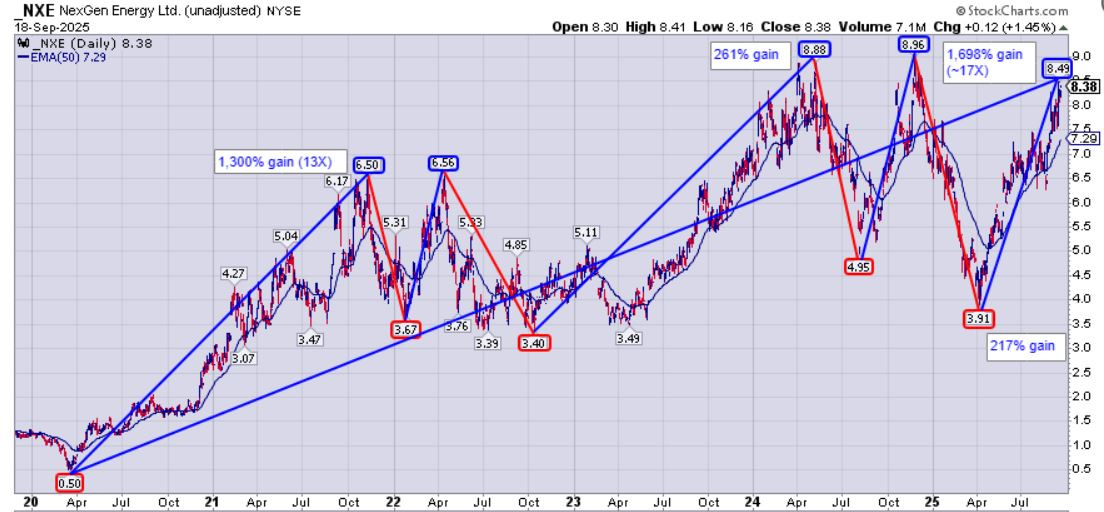
NexGen Energy (NYSE: NXE) is one of the most popular uranium stocks, and as previously established, has a world class tier one project of significance in Arrow (Rook 1). As a result of being so widely-held and loved, this stock can really move during bullish impulse waves in the evolving secular bull market.
(NXE) moved up 1,300% (13X) off the 2020 Major Low of $0.50 to the late 2021 peak of $6.50.
(NXE) has seen a 2.6X and 2.1X move off intermediate lows over the last couple years.
The cumulative move in (NXE) during this secular bull, from the 2020 Major Low of $0.50 up to the recent peak of $8.49 has been 1,698% gain (a 17-bagger!)
As one can see by the chart-based data above, that the uranium stocks have a history of simply amazing surges to the upside, and then gut-wrenching dives to the downside; but the sector has been in an overall uptrend for the last 5+ years.
While the “easy money has already been made,” over the last handful of years; in my estimation there is still plenty of upside left in this sector. The real “mania” or “acceleration phase” appears to have just kicked off after those April 2025 tariff tantrum intermediate lows, where we’ve seen a string of bullish macro headlines.
My investing thesis for holding these U-stocks highlighted above in my portfolio is that many of these stocks will still go up another 2x-5x off their current levels. {That’s definitely not investing advice, and I’m merely sharing my personal investing thesis and what I’m doing with my own money in my portfolio for entertainment purposes.}
Thanks for reading and may you have prosperity in your trading and in life!
Shad